
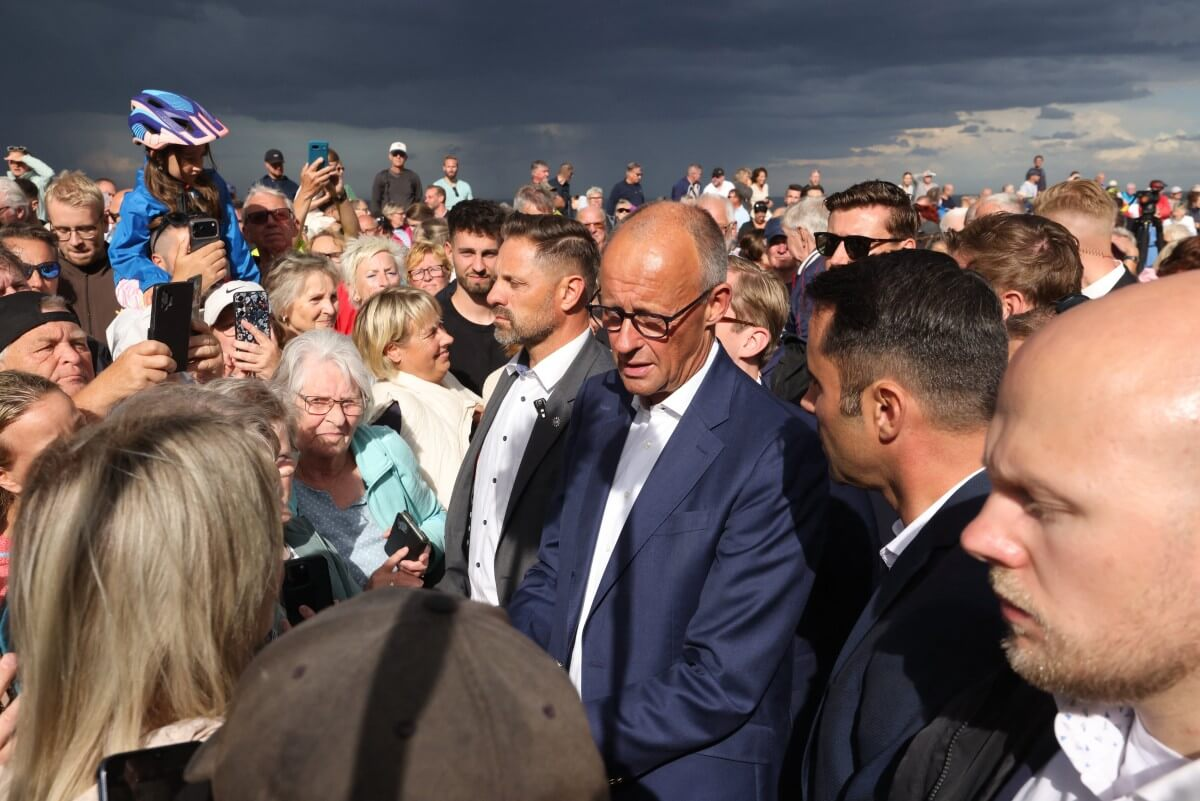
German Chancellor Friedrich Merz's Christian Democratic Union has suffered a historic electoral defeat, failing to enter the state parliament of Mecklenburg-Western Pomerania after falling below Germany's 5% electoral threshold.
According to the preliminary result from Sunday's state election, the CDU secured only 4.9% of the vote. It is the first time the party has failed to gain representation in a German state parliament because it did not clear the threshold.
The result represents the CDU's worst performance in any German state election since 1949 and increases political pressure on Merz following a difficult series of regional contests. In the previous Mecklenburg-Western Pomerania election in 2021, the CDU had secured 13.3%, meaning its support has fallen by more than eight percentage points.
Sunday's election also produced a significant shift at the top of the state's political landscape.
The Alternative for Germany (AfD) finished first with 38.2%, more than doubling its 16.7% result from 2021. The governing Social Democratic Party, led in the state by premier Manuela Schwesig, finished close behind on 35.5%, down from 39.6% five years earlier.
Despite finishing first, the AfD does not automatically take control of the state government. Germany's parliamentary system requires a government to command sufficient support in the legislature, and the other parties have ruled out governing in coalition with the AfD.
CDU Suffers a Result Without Precedent in Its State-Election History
The 4.9% result is particularly significant because of the CDU's long-established position in German politics.
Since Germany's postwar political system developed, the Christian Democrats have been one of the country's dominant parties, producing chancellors including Konrad Adenauer, Helmut Kohl, Angela Merkel and now Friedrich Merz.
Mecklenburg-Western Pomerania itself has historically been difficult territory for the CDU. The party won the state's first two post-reunification elections in 1990 and 1994, but the SPD had finished ahead of it in every state election from 1998 through 2021.
Even against that background, Sunday's result marks a new low.
CDU lead candidate Daniel Peters failed to keep the party above the 5% threshold, leaving the Christian Democrats without proportional representation in the new state parliament.
The outcome also came on the same day that the CDU lost ground in Berlin, where it received about 19% as the Left Party emerged as the strongest party.
Together, the two elections have intensified scrutiny of Merz's leadership and his federal government's reform programme.
Merz described the results as a “disaster” but indicated that he intends to remain both chancellor and CDU leader and continue pursuing his government's reforms.
AfD Finishes First but Faces a Difficult Route to Government
For the AfD, Mecklenburg-Western Pomerania represents another substantial electoral advance in eastern Germany.
Its 38.2% preliminary result is more than twice the 16.7% it received in the state in 2021. It follows strong recent performances elsewhere in eastern Germany and reinforces the party's growing electoral presence in the region.
But winning the largest share of votes does not guarantee that the AfD will lead the next government.
Other established parties continue to reject coalition arrangements with it, a policy frequently described in German politics as a political “firewall.” Without coalition partners, the AfD faces difficulty assembling the parliamentary support necessary to form a government despite finishing first.
That leaves Schwesig's SPD in an unusual position.
Although it finished second and lost support compared with 2021, its 35.5% result was considerably stronger than some pre-election polling had suggested and could leave Schwesig with a viable path towards remaining state premier.
The Left Party finished third on 6.5%, while the Greens cleared the threshold with 5.7%.
The Sahra Wagenknecht Alliance narrowly missed representation with 4.8%, while the FDP received approximately 1%.
Those numbers make coalition building more complicated. The SPD and Left no longer have enough seats to simply continue their existing two-party government. Based on the preliminary result, a combination involving the SPD, Left and Greens offers a possible parliamentary majority. Schwesig has said she will hold discussions with democratic parties about forming the next government.
Result Adds to Pressure on Chancellor Merz
Although this was a state election involving roughly 1.6 million residents rather than a federal vote, the result has consequences extending beyond Mecklenburg-Western Pomerania.
Merz's federal government has been pursuing changes involving pensions, healthcare, taxation and the economy at a time when German households are confronting high energy and housing costs. Reuters reports that dissatisfaction with those policies has contributed to pressure on the governing parties, although voting behaviour reflects multiple local and national factors.
The CDU's performance is therefore likely to intensify debate inside the party over its strategy.
It also creates a difficult balance for Merz.
Changing course after regional election losses could be interpreted by critics inside his coalition as recognition that parts of the government's programme require adjustment. Continuing unchanged risks further conflict with regional leaders and coalition partners who argue that voters are rejecting elements of the reform agenda.
Merz has so far chosen the latter course, saying the reforms must proceed.
The election does not itself determine the future of his federal government, and it should not be treated as a nationwide measure of German voter opinion. It does, however, provide a significant political warning for the CDU.
For Mecklenburg-Western Pomerania, attention now moves from campaigning to coalition negotiations.
For the CDU, the result carries a more lasting historical significance: a party that has been central to Germany's postwar political system has, for the first time, fallen below the threshold required to enter one of the country's state parliaments.