
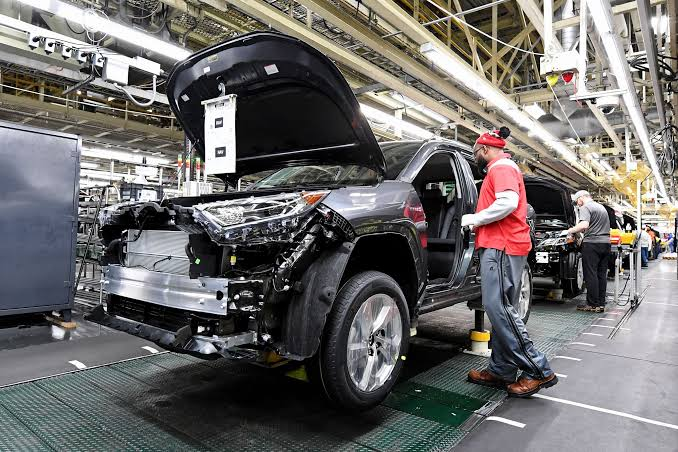
The world's largest automaker is preparing for an expensive transformation of the factory floor.
Toyota estimates it could require around 1 trillion yen — approximately $6.4 billion — every year from 2028 to modernise its factories, as the Japanese carmaker accelerates investment in automation and robotics.
The scale of the potential spending demonstrates how dramatically vehicle manufacturing is changing.
For Toyota and its competitors, the next generation of factories will not simply be about installing more robots. Manufacturers are trying to build production systems capable of operating with fewer workers, adapting more quickly to different vehicles and keeping older factories competitive.
Toyota Is Preparing for a Huge Manufacturing Investment
Toyota's estimate covers the enormous amount of investment that may be required to modernise its global production system.
The company operates factories across multiple continents, producing millions of vehicles each year.
Keeping such a manufacturing network competitive requires continuous investment.
Equipment ages. Production methods change. New vehicle technologies require different processes.
Automation is increasingly becoming part of the answer.
Toyota estimates annual modernisation costs could reach 1 trillion yen from 2028, according to Reuters.
That is roughly $6.4 billion at current exchange rates.
Why Automakers Are Spending More on Robots
Automotive factories have used robots for decades.
Large robotic arms already weld vehicle bodies, paint panels and move heavy components through assembly plants.
The new automation wave goes further.
Manufacturers are increasingly interested in machines capable of performing more complicated tasks, working alongside people and adapting to changing production requirements.
Robotics can also address a problem facing manufacturers in several developed economies: labour shortages.
As workforces age and fewer people enter some industrial occupations, automakers are looking for technology that can maintain production without requiring the same number of workers for physically demanding tasks.
Ageing Factories Are Becoming Expensive
The physical age of manufacturing facilities presents another challenge.
Factories can operate for decades.
But a plant designed around vehicles and manufacturing technology from a previous generation may become increasingly expensive to maintain.
Older equipment can consume more energy.
Production lines may require more workers.
Changing the factory to produce a new model can also take longer.
Modernisation therefore becomes a competitiveness issue rather than merely an efficiency project.
Toyota must decide whether individual factories should be upgraded, rebuilt or redesigned around newer production methods.
Automation Is About More Than Cutting Jobs
Factory automation is frequently discussed primarily in terms of replacing workers.
The reality is more complicated.
Robots are particularly useful for jobs that are repetitive, dangerous, extremely precise or physically demanding.
A machine can repeatedly lift a heavy component without becoming fatigued.
Automated inspection systems can examine thousands of parts for manufacturing defects.
Robotic systems can work around equipment where heat, chemicals or heavy machinery create risks for people.
Human workers can then move towards supervision, maintenance, engineering, quality control and other tasks.
That does not mean automation has no employment consequences.
Some jobs can disappear.
Others change significantly.
But the transformation is usually broader than a simple one-worker-for-one-robot replacement.
Toyota Has Long Been Known for Manufacturing Efficiency
Toyota occupies a special place in industrial management.
Its production philosophy influenced factories around the world.
Concepts associated with the Toyota Production System, including continuous improvement and reducing unnecessary inventory, became widely studied far beyond the automotive sector.
The company's manufacturing reputation was built partly around eliminating waste rather than simply maximising automation.
That history makes its current robotics push particularly significant.
Toyota is not abandoning efficiency principles.
Instead, it is trying to apply them to a manufacturing environment increasingly shaped by software, sensors and intelligent machines.
Electric Vehicles Are Changing the Factory
The transition towards electric and electrified vehicles is another reason factories are changing.
A battery-electric vehicle has a different powertrain from a conventional petrol or diesel car.
There is no traditional internal-combustion engine.
Battery packs require specialised manufacturing and handling.
Electric motors and power electronics create different supply chains.
Automakers therefore cannot assume that factories designed for combustion-engine vehicles will remain ideal indefinitely.
Even companies pursuing a mix of hybrids, plug-in hybrids, battery-electric cars and conventional vehicles need manufacturing systems capable of handling greater complexity.
Flexible Factories Could Become More Valuable
Traditional automotive manufacturing works best when enormous numbers of similar vehicles move through a production line.
But consumer demand can change rapidly.
One model may suddenly become popular while another loses momentum.
Electric-vehicle demand can also vary considerably by country.
That makes manufacturing flexibility increasingly valuable.
A factory capable of producing several vehicle types with minimal reconfiguration can respond more quickly when demand changes.
Automation and software can help make that possible.
Robotic systems can sometimes be reprogrammed much faster than traditional fixed machinery can be rebuilt.
AI Is Beginning to Enter Manufacturing
Artificial intelligence is also moving from office software into industrial operations.
Computer-vision systems can inspect components.
Predictive-maintenance software can identify equipment that may fail before it stops working.
AI can analyse production data to detect bottlenecks or unusual patterns.
Robots can increasingly use machine vision to identify and manipulate objects rather than following only predetermined movements.
The factory of the future therefore combines several technologies.
Robotics provides physical automation.
Sensors collect information.
AI interprets the information.
Software coordinates the overall production system.
Humanoid Robots Could Eventually Join the Factory Floor
One of the most closely watched areas is humanoid robotics.
Companies around the world are developing machines with arms, legs and body structures designed to operate in environments originally built for humans.
The attraction is obvious.
Factories already contain stairs, tools, shelves and workstations designed around human bodies.
A sufficiently capable humanoid robot could theoretically work in those environments without requiring the entire facility to be redesigned.
But the technology is still developing.
Reliability, cost and safety will determine whether humanoid robots become genuinely useful industrial workers rather than impressive demonstrations.
Toyota Is Not Alone
The broader automotive industry is pursuing similar strategies.
Automakers are turning towards robotics as they seek lower costs and solutions to labour and infrastructure challenges, Reuters reported.
That creates another business opportunity.
The transformation of automotive factories could generate demand not only for industrial robots but also for sensors, semiconductors, automation software, machine-vision systems and specialist engineering.
The beneficiaries of factory automation therefore extend far beyond car companies.
Robotics Companies See a Massive Industrial Market
Automotive manufacturing has historically been one of the world's largest markets for industrial robots.
A modern car contains thousands of components and requires extraordinary consistency.
Tiny manufacturing errors can create expensive recalls.
Automation helps companies repeat processes accurately across huge production volumes.
As robots become more capable, the number of tasks they can perform could expand.
That means automotive investment can become a major growth engine for the robotics industry itself.
The Economics Must Still Make Sense
Robots are not free labour.
Industrial automation requires substantial upfront investment.
Machines must be purchased.
Software must be developed.
Factories may need modification.
Employees need training.
Robots also require maintenance and eventually replacement.
That means companies must calculate whether the productivity improvements justify the investment.
Toyota's estimated $6.4 billion annual modernisation requirement shows how expensive that calculation can become at global scale.
Automation Could Change Where Cars Are Built
Manufacturing labour costs have historically influenced where companies locate factories.
If automation reduces the labour required to produce a vehicle, other factors can become more important.
Energy costs matter.
Logistics matter.
Access to suppliers matters.
Government incentives matter.
Proximity to customers matters.
Highly automated production could therefore influence future decisions about where factories are constructed.
It could potentially make manufacturing in higher-wage economies more competitive for certain products.
Workers Will Need Different Skills
A more automated factory changes the skills employers need.
Traditional assembly experience remains valuable, but manufacturers increasingly need workers who understand robotics, software, electronics and data.
Maintenance also becomes more technically demanding.
Repairing a mechanical production line and diagnosing a networked robotic system can require very different expertise.
This creates pressure on companies and governments to expand technical education and retraining.
The industrial workforce does not simply become smaller.
It becomes more technologically specialised.
Reliability Will Be Critical
Automation brings efficiency, but it can also concentrate risk.
If one worker experiences a problem, production may slow locally.
If a central automated system fails, an entire production line can potentially stop.
Manufacturers therefore need redundancy and strong maintenance systems.
Cybersecurity also becomes more important.
A factory filled with connected equipment creates more digital systems that must be protected.
The more intelligent factories become, the more closely manufacturing and information technology begin to overlap.
Toyota's Scale Makes the Shift Important
Toyota's production footprint means its decisions can influence suppliers throughout the automotive industry.
When a company of Toyota's size changes manufacturing methods, component suppliers and equipment manufacturers often need to adapt.
A new production system may require different parts.
New robots require new tooling.
More sensors create demand for electronics.
Changes therefore ripple through the industrial supply chain.
That is why Toyota's automation plans matter beyond Toyota itself.
The Auto Industry Is Becoming a Technology Industry
Modern vehicles increasingly resemble computers on wheels.
Factories are following the same direction.
Software controls production equipment.
AI analyses quality.
Robots handle physical work.
Digital twins can simulate manufacturing processes before equipment is installed.
Data flows continuously between machines and management systems.
The distinction between a traditional industrial company and a technology company is becoming less clear.
What Happens Next?
The key period begins around 2028, when Toyota estimates its annual factory-modernisation costs could reach approximately 1 trillion yen.
How that money is allocated will show which technologies the company believes can produce meaningful improvements at industrial scale.
Robotics will be one of the most closely watched areas.
But the larger story is about the transformation of manufacturing itself.
For more than a century, automobile factories have evolved from human assembly lines to mechanised mass production and then industrial robotics.
The next phase could combine robots, artificial intelligence, sensors and highly flexible production systems into factories capable of adapting almost as quickly as the products they build.
Toyota's potential $6.4 billion annual bill demonstrates one important reality:
the factory of the future may be more efficient — but building it will be extremely expensive.